Nikolai Nikolaievich Vedeniapin
Doctor ZhivagoNikolai Nikolaievich Vedeniapin is Yurii Andreievich Zhivago’s maternal uncle, a former priest who asked to be unfrocked and a thinker whose account of history as humanity’s answer to death becomes one of the foundations of Yurii’s intellectual life. He first appears not as an abstract teacher but as a bereaved child’s guide out of the cemetery: after Maria Nikolaievna Zhivago’s funeral, he leads the weeping Yurii away and takes him into his care. His influence endures in Yurii’s ideas about art, history, and the life of the individual.
Identity and early guardianship
Nikolai is the brother of Maria Nikolaievna Zhivago and therefore Yurii’s maternal uncle. Yurii also remembers him affectionately as Uncle Kolia. The book establishes Nikolai’s religious past and independent temperament together: he was a priest, but had himself unfrocked. The choice carries practical consequences, including a prolonged ban from civil service and a prohibition on living in Moscow or St. Petersburg, restrictions he nevertheless calls trifles beside the question of how a person ought to live.
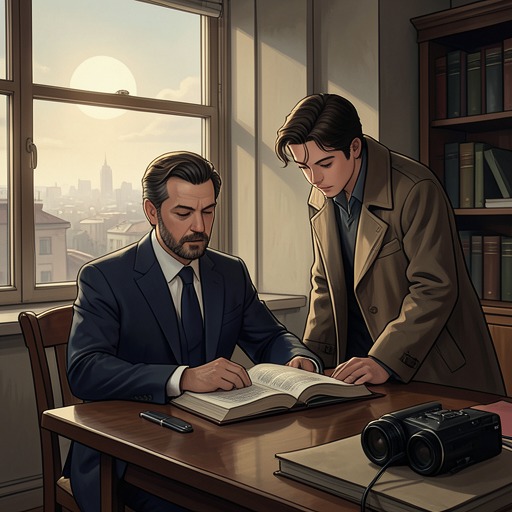
Nikolai’s guardianship begins at the funeral of Maria Nikolaievna. As the mourners leave the graveyard, her ten-year-old son collapses into sobs on the freshly filled mound. Nikolai approaches him, identifies himself through his relation to the dead woman and the child, and leads him out of the cemetery. The scene gives his influence an intimate starting point: before he shapes Yurii’s thought, he is the adult who meets the boy at the moment his mother is gone.
That care also has a spiritual dimension. At Duplyanka, while feeling lonely and remembering his mother, Yurii prays that she be received among the saints and that she not suffer. He calls to her as though she were a patron saint, then faints. When he recovers, he remembers that he has neglected to pray for his missing father, as Maria had taught him. This memory shows the religious language of childhood surrounding Yurii’s bereavement, while Nikolai’s influence belongs to the living relationship through which the boy is guided and educated.
A faith grounded in history and individual truth
Nikolai’s conversation with Ivan Ivanovich Voskoboinikov sets out his resistance to intellectual conformity. He distrusts groups and societies when their members’ allegiance to a system takes precedence over truth, arguing that only individuals seek truth for its own sake. The same emphasis informs his defense of religious belief. He does not present faith as dependent on certainty that God exists: a person may be an atheist, or unsure whether God exists, and still recognize that human life takes place in history rather than in a state of nature.
For Nikolai, history in its modern sense begins with Christ and rests on the Gospel. He describes its long movement as a systematic effort to solve the riddle of death and overcome death. Mathematics, scientific discovery, and symphonies belong to this effort: different forms of human work answer the same fundamental challenge. His Christianity is therefore not simply a profession of church authority. It provides a framework for understanding human creativity and historical life, even as his own decision to leave the priesthood places him at a distance from religious institution.
The distinction between organized allegiance and living conviction matters to his relationship with Yurii. Nikolai’s thought joins religious language to a defense of individual freedom, without demanding that everyone arrive at belief by the same route. His own conversation with Voskoboinikov makes this position vivid: when challenged about the consequences of being unfrocked, he answers the question but returns to his central point, treating the penalties as secondary to fidelity to Christ and to the life he associates with immortality.
Influence on Yurii and his writing
Yurii later recognizes how large a part Nikolai played in forming his character. As a young man, Yurii dreams of writing a book about life, gathering into it the striking things he has seen and thought. Since he considers himself too young for that project, he writes poems as sketches toward the larger work. His belief that vigor and originality give art reality is compatible with Nikolai’s insistence that creativity answers to life rather than to fashion or collective approval.
The influence is not identical in Yurii and Misha Gordon. Misha is more deeply taken by Nikolai’s ideas: they lead him to register at the Faculty of Philosophy, attend theology lectures, and consider transferring to a theological academy. Yurii, by contrast, advances and becomes freer under the influence of his uncle’s theories. He does not try to argue Misha out of his extravagant enthusiasms, but wishes that his friend were more realist and down-to-earth. The contrast suggests that Nikolai’s teaching is not a formula producing the same result in everyone; Yurii’s independence develops partly through his own way of taking it up.
Nikolai’s later writings continue the intellectual work that began in these conversations. Living in Lausanne, he publishes books in Russian and in translation, developing his view of history as another universe made by human beings with the help of time and memory in answer to death. The books grow from a new interpretation of Christianity and lead toward a new conception of art. In this later account, memory and artistic creation do not stand outside history: they are among the means through which human beings make a world and resist death.
Return through memory and sacred time
Nikolai’s significance also persists indirectly, through the forms and ideas that recur across the book. A church service attended by Lara includes the psalm beginning, “Bless the Lord, O my soul: and all that is within me, bless His holy name.” Later, Yurii’s writing recalls spring through Chapter Seven of Evgenii Onegin, where the deserted house and Lensky’s grave accompany the nightingale’s song. These scenes do not establish Nikolai’s presence in their immediate action, but they illuminate the religious and literary vocabularies within which he had helped shape Yurii’s understanding.
The calendar of Christian observance supplies another frame for that continuing resonance. The book’s later poems mark the interval from Maundy Thursday to the eve of Easter, joining seasonal change to the Christian passage through suffering toward renewal. Nikolai’s account of history as a struggle with death helps clarify why these liturgical references matter to Yurii’s imaginative world: religious time and artistic memory offer ways of apprehending loss without reducing life to political chronology or private grief alone.
Nikolai’s narrative role is thus larger than that of a relative who temporarily cares for a bereaved child. He is an early interpreter of the novel’s central questions: how human beings answer death, what makes history more than the passage of events, and whether art can remain truthful without submission to a group’s ready-made doctrine. His influence does not turn Yurii into a disciple. It helps him become more independent, giving him a language in which faith, memory, individual truth, and creative life can remain connected without collapsing into one another.